Sunday, 5 June 2011

Michael Faraday School

Cartlidge Levene is behind a new wayfinding system for a regenerated school in Southwark in London. The work includes a series of visual 'shopfronts' to each of the classrooms and a range of playful signage...

The Michael Faraday Community School in Southwark (the chemist and physicist was born in what is now part of the London borough in 1791) was developed by architectural firm, Archial.

The primary school is one of the first to be transformed as part of the Southwark Schools for the Future programme. It accommodates a primary school, nursery, adult education and community facilities, and an after-school play group.
The structure of the build is based on a 'circular footprint' with a flexible learning space, called the Living Room, in the centre. Classrooms for year groups one to six are arranged around the perimeter and are connected by the central communal space. The Living Room features a bright yellow, double height wall which encloses both the Studio and Roof Garden teaching spaces.

Cartlidge Levene was briefed to develop a wayfinding system that would engage the children, engendering a feeling of pride in their school, and that integrated with the architecture. Ultimately, say the studio, the visual language aims to provide a new graphic identity for the school and work alongside the Faraday logotype that is mounted above the main entrance.


Also of note are the year group classrooms that form a continuous row of ‘shopfronts' around the circular space over two levels. Differently coloured flag-signs fold out from these shopfronts to identify each year group. The studio also devised methods of displaying the children's work to provide an ordered but flexible system that could be easily operated by the teachers. The signage takes advantage of the intuitive building arrangement with, according to the studio, good sight-lines across the central, circular space. Furthermore, playful, 3D arrows are used to sign the 'Studio' and 'Roof Garden' teaching spaces and supporting facilities.

The use of terminology such as Roof Garden and Living Room (for the teaching spaces) and even 'Ballroom' (for the external pavilion that houses sports and dining facilities) was developed, say the studio, to create "a fun nomenclature that the children can relate to". The Ballroom sign is integrated into the building's cladding, along with a layer of decorative pattern and, in the toilet blocks a ‘paper chain' of male and female toilet icons has been applied to the doors.


Saturday, 4 June 2011

Pearls Lace and Ruffles GIVEAWAY!

The lovely Dee at Pearls Lace and Ruffles  is celebrating her 1 year anniversary of blogging. She is doing a very generous giveaway of cute and girly jewelry. 
The first prize will include A matching necklace, bracelet & toe ring set. The cute heart shaped lockets open,

The Second Prize will include Two necklaces - a long length necklace with birdcage charm, inside is a cute moving bird. The second necklace is a pretty black and gold bow. 
Here Dee explains the rules:

"RULES"
♥ You must be a follower of my blog (via google friend connect in the sidebar) to enter
♥ You get one entry for following my blog (additional entries can be gained too, see below!)
♥ The giveaway is open to everyone, all over the world
♥ The winners will be chosen using random.org
♥ To enter simply comment with your name and email address

ADDITIONAL ENTRIES 
♥ Blog about this giveaway OR add it to your sidebar (two entries)
♥ Tweet about this giveaway with a link back to this post (one entry)
♥ Become a fan of my blog on Facebook (one entry)
♥ Please leave a separate comment for each additional entry or they won't be counted!

The giveaway ends on Friday 24th June 2011 at 10pm GMT. 


Monday, 30 May 2011

Audi ad reveals Le Mans driver experience


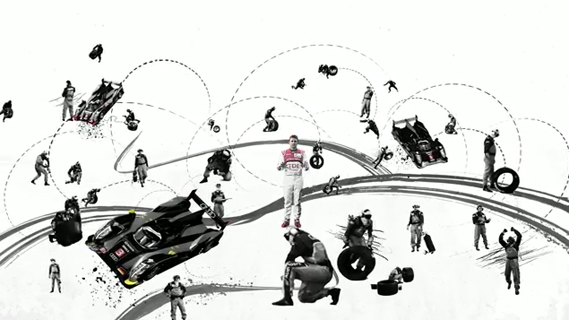
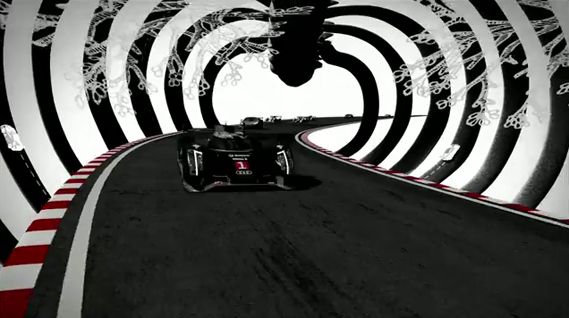
This beautiful new ad for Audi from BBH London stars Audi Le Mans team leader Allan McNish and gives a real insight into the physical endurance required to be a Le Mans driver...

Directed by Chris Hemming at Passion Pictures, the ad is two-and-a-half minutes in length and incorporates a mixture of live action, hand-drawn sketches and stereoscopic techniques. The 2D version is shown above, but a 3D version will play out on Sky 3D during the Champions League final on Saturday and also in cinemas.
"Audi were keen to promote Le Mans, as it is an unsung success for them," says Kevin Stark, creative director at BBH. "They have won it nine out of eleven times in the last few years. I was lucky to see Le Mans winner Allan McNish at the Audi National Forum. He did a five-minute lecture on the famous endurance race, but from the driver's  perspective. I thought this might have potential to answer our brief. We wanted to bring a human aspect to Audi communications and Allan's off-beat and likeable style was a good fit."

"Next step was to get this into a manageable time length film," continues Stark. "And also see if we could further increase the exciting, sensory experience of driving the race. We approached animator Chris Hemming at Passion Pictures. Chris and his artist Tim Marrs did some great, expressive style sketches that enhanced what Allan was saying but without drowning his performance. Allan was filmed using 3D live action cameras, but Chris had the idea that we could make the hand-drawn sketch style 3D too, but also using stereoscopic techniques. The result is a fresh-looking piece of animation that works well in 2D but really comes alive in 3D."

Credits:
Ad agency: BBH London
ECD: Nick Gill
Senior creative directors: Nick Kidney, Kevin Stark
Production company: Passion Pictures
Director: Chris Hemming


Wednesday, 25 May 2011

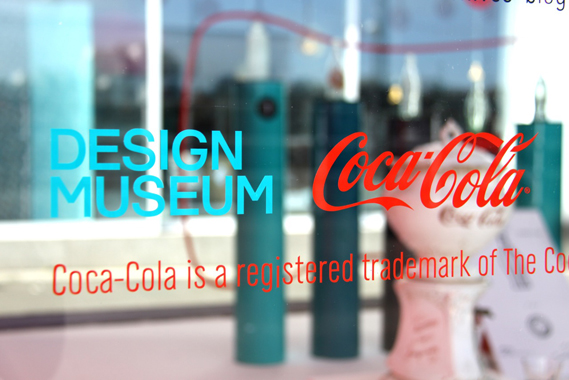
Coca-Cola at the Design Museum

To celebrate its 125th anniversary, Coca-Cola has just opened a new display on the history of its visual identity at the Design Museum in London...

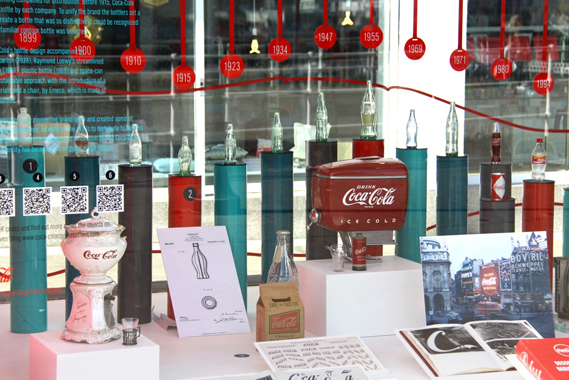
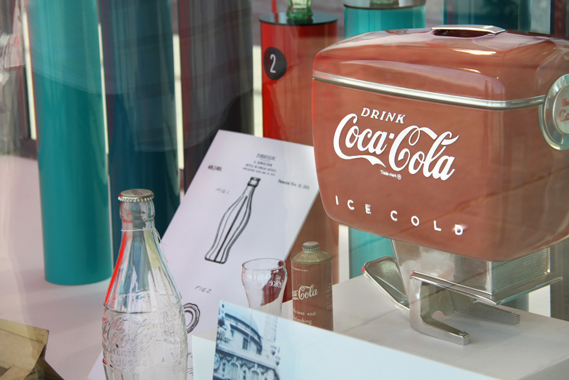
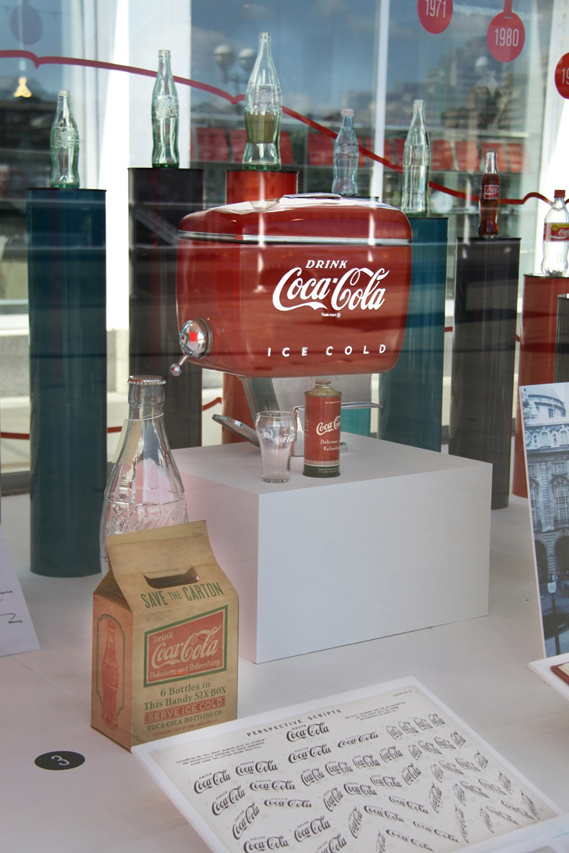
The exhibition fills the Design Museum's glass tank and features some rarities from the Coke archives, commonly housed in a vault in the Coca-Cola headquarters in Atlanta. The display also shows that while differently shaped Coke bottles have come and gone, the brand's visual identity has survived largely unchanged in 125 years. 

The Coca-Cola logo itself was created by Frank Robinson in 1886 and was written out in Spencerian script because that was the favoured typeface of accounting folk at that time. Robinson was Coca-Cola inventor John S Pemberton's book-keeper.

One of the stand-out pieces in the tank (though designers will love the rare design manuals and identity guidelines on show) is the Raymond Loewy-designed fountain dispenser, shown above. First made in 1947, it resembles a sleek speedboat engine.


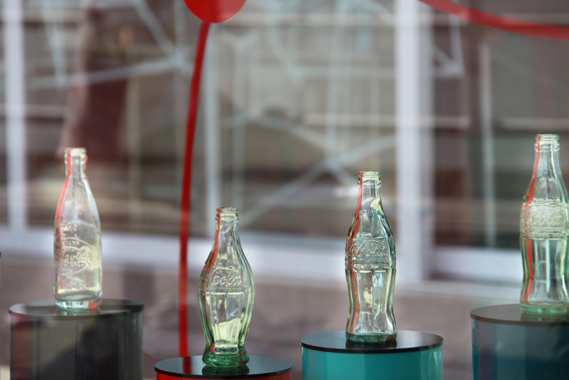
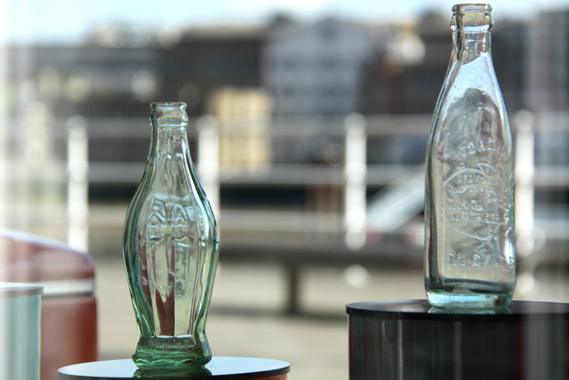
Occupying the rear of the Design Museum's tank is a display of several Coca-Cola bottles, charting the subtle changes in shape that have occurred since the straight-sided Hutchinson bottle launched in 1899.

When first designed, the now more familiar curvy frame of the Coke bottle was actually a reference the shape of the cocoa bean (though the bean has nothing to do with the drink) and the form has moved in and out of fashion ever since.

Take a virtual tour the Coca-Cola archives at theverybestofcocacola.com and get across to Shad Thames in London for a close-up look at the objects on display.

The Coca-Cola exhibition is on at the Design Museum until July 3.


In the foreground, above: a sheet of Coca-Cola logos applied in different perspectives.


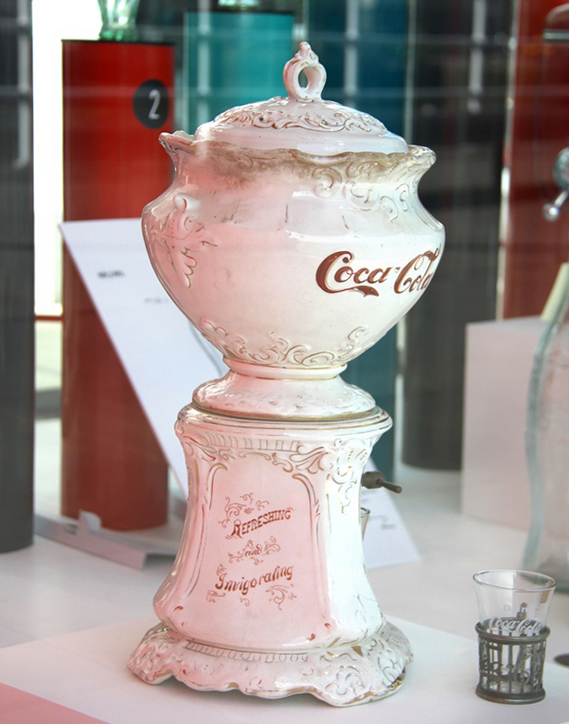
This dispenser is one of the oldest objects in the Coca-Cola archive, from 1886. It dispensed syprup that was then mixed with carbonated water.


Tuesday, 24 May 2011

Denmark bans sale of yeasty Marmite spread


Denmark has already threatened to reimpose national border checks to control immigration, now it has moved to expel the savoury spread Marmite.

Danish officials say the product breaks food safety laws because of its added vitamins and minerals. The Danish authorities must give their permission for products with such additives to be sold.

Over the past few years several well known items including breakfast cereals have been banned.Already a shop in Copenhagen has been ordered to remove jars of Marmite from its shelves, says the BBC's Europe correspondent, Chris Morris, in Brussels. He says outraged expats in the country are already threatening a campaign of civil disobedience and there are suggestions that the Danish ban could break European law.